
Barry Kirsch's Extraordinary Life: Artist, Storyteller, and Gardener
Artist, storyteller, and master gardener Barry Kirsch doesn't simply reside at Restoration Cottage in Sanford's Historic District — he lives an extraordinary life there, sharing his 113-year-old home and whimsical garden with his wife Debbie, cat Misty, and seven fairy robots.
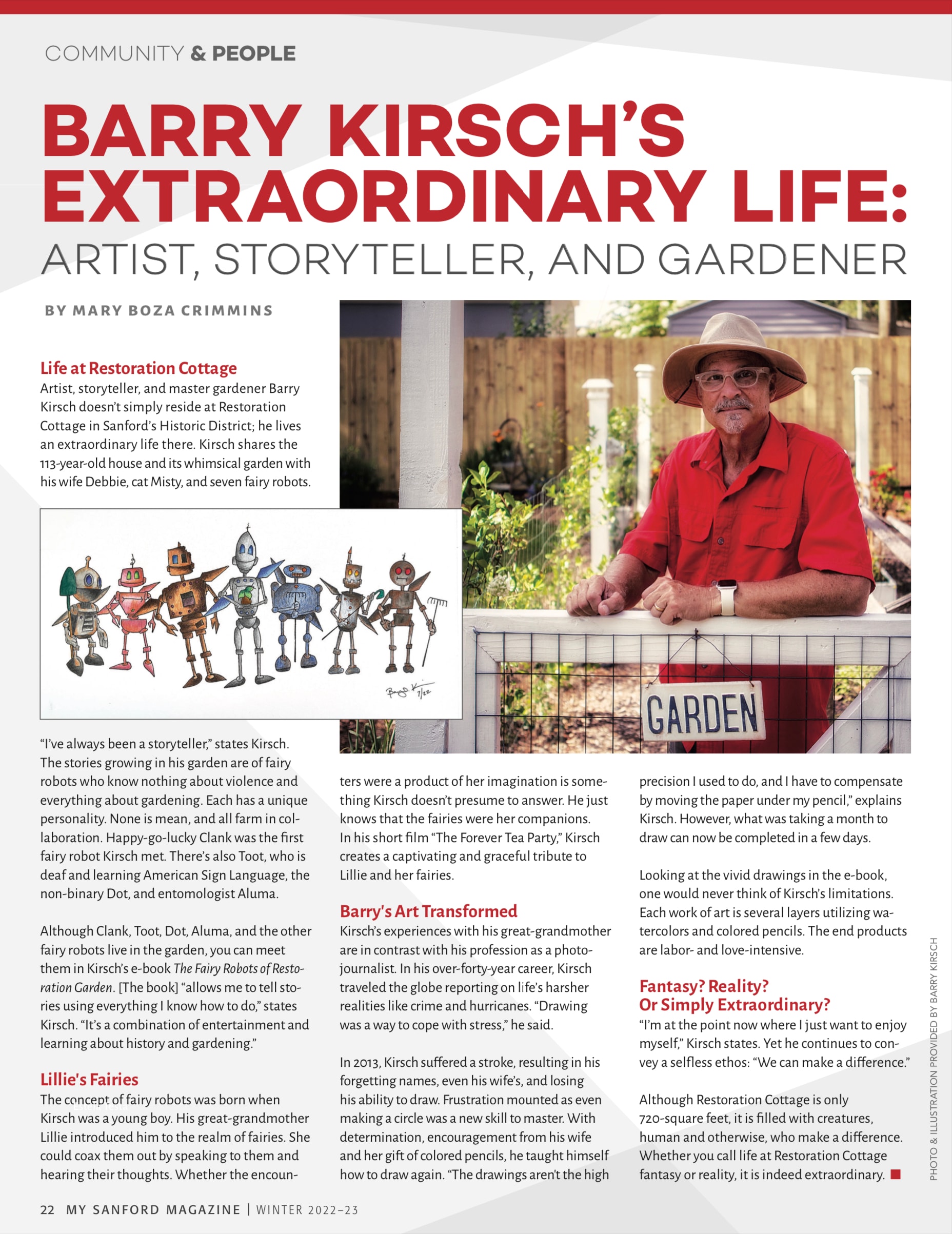
Artist, storyteller, and master gardener Barry Kirsch doesn't simply reside at Restoration Cottage in Sanford's Historic District; he lives an extraordinary life there. Kirsch shares the 113-year-old house and its whimsical garden with his wife Debbie, cat Misty, and seven fairy robots.
"I've always been a storyteller," states Kirsch. The stories growing in his garden are of fairy robots who know nothing about violence and everything about gardening. Each has a unique personality. None is mean, and all farm in collaboration. Happy-go-lucky Clank was the first fairy robot Kirsch met. There's also Toot, who is deaf and learning American Sign Language, the non-binary Dot, and entomologist Aluma.
Although Clank, Toot, Dot, Aluma, and the other fairy robots live in the garden, you can meet them in Kirsch's e-book The Fairy Robots of Restoration Garden. The book "allows me to tell stories using everything I know how to do," states Kirsch. "It's a combination of entertainment and learning about history and gardening."
The concept of fairy robots was born when Kirsch was a young boy. His great-grandmother Lillie introduced him to the realm of fairies. She could coax them out by speaking to them and hearing their thoughts. Whether the encounters were a product of her imagination is something Kirsch doesn't presume to answer. He just knows that the fairies were her companions. In his short film "The Forever Tea Party," Kirsch creates a captivating and graceful tribute to Lillie and her fairies.
Kirsch's experiences with his great-grandmother are in contrast with his profession as a photojournalist. In his over-forty-year career, Kirsch traveled the globe reporting on life's harsher realities like crime and hurricanes. "Drawing was a way to cope with stress," he said.
In 2013, Kirsch suffered a stroke, resulting in his forgetting names, even his wife's, and losing his ability to draw. Frustration mounted as even making a circle was a new skill to master. With determination, encouragement from his wife and her gift of colored pencils, he taught himself how to draw again. "The drawings aren't the high precision I used to do, and I have to compensate by moving the paper under my pencil," explains Kirsch. However, what was taking a month to draw can now be completed in a few days.
Looking at the vivid drawings in the e-book, one would never think of Kirsch's limitations. Each work of art is several layers utilising watercolours and coloured pencils. The end products are labour- and love-intensive.
"I'm at the point now where I just want to enjoy myself," Kirsch states. Yet he continues to convey a selfless ethos: "We can make a difference."
Although Restoration Cottage is only 720-square feet, it is filled with creatures, human and otherwise, who make a difference. Whether you call life at Restoration Cottage fantasy or reality, it is indeed extraordinary.